
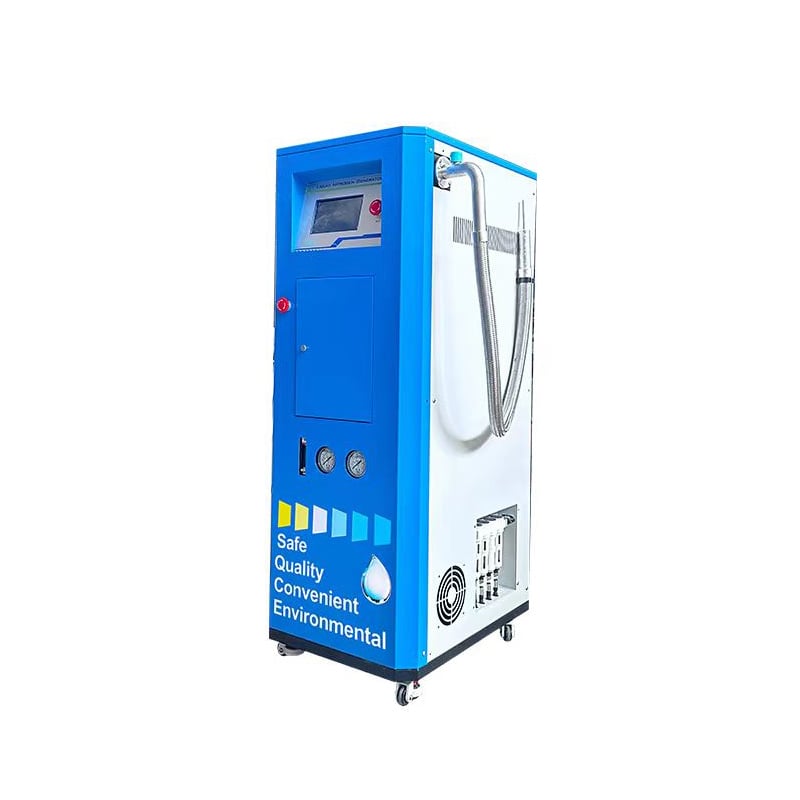

1. What is Liquid Nitrogen for Seafood?
Liquid Nitrogen for Seafood Preservation means the application of cryogenic nitrogen for quick seafood freezing and cooling. Liquid nitrogen boils at around −196° C at atmospheric pressure. As a result, it creates an extremely cold environment for industrial food processing applications. Processors can direct liquid nitrogen onto products to quickly draw heat away. As a result, freezing times can be much less than is typical with many other processes.
Common uses include:
l Fish Freezing
l Shrimp Freezing
l Shellfish Processing
l Seafood Portions Freezing
l Rapid Surface Freezing
l Process Temperature Control
l Specialty Seafood Processing
Liquid nitrogen freezing does not eliminate the need for refrigerated storage after processing. The processor will still need proper cold-chain management. Industrial Use
2. Why Does Seafood Need to Be Frozen Quickly?
Seafood can spoil within a short time after harvest. As a result, temperature control is crucial during processing and transportation. Fish and shellfish are also made of a large percentage of water. Moreover, their quality degrades due to microbial growth, chemical activity, and enzymes. Cold temperatures can slow down these processes. Freezing allows for even longer storage if the processors keep the proper temperatures. However, the freezing rate also affects the quality of the product. Generally, slower freezing allows more time for larger ice crystals to form. Rapid freezing gives the crystals less time to grow. Cryogenic freezing offers unique opportunities for freezing high-value seafood products.
3. How Does Liquid Nitrogen Freeze Seafood?
Liquid nitrogen freezes seafood through rapid heat extraction. First, the seafood loads into a cryogenic freezing tunnel. Next, the system floods the tunnel with liquid nitrogen. Then the liquid absorbs heat from the seafood. As it warms, the nitrogen boils off into a gas. This rapid phase change pulls heat from the seafood. Consequently, the temperature of the seafood drops quickly. After freezing, workers transport the product to appropriate frozen storage. Liquid nitrogen provides freezing speed rather than a total storage solution.
4. Cryogenic Freezing
Industrial Cryogenic Freezing involves using extremely cold liquids or gases to freeze food products. A common cryogenic temperature for food products is liquid nitrogen. Many systems use a tunnel freezer for processing seafood products. The seafood loads onto a conveyor and moves continuously through the tunnel. At the same time, the system controls nitrogen flow rates and temperatures within the tunnel. Some systems spray liquid nitrogen on the product. Other systems expose the product to cryogenic temperatures differently.
The ideal system configuration depends on factors such as:
l Product dimensions
l Product density
l Starting temperature
l Desired temperature
l Production capacity
l Freeze time
l Quality specifications
For these reasons, processors should design a freezing system around their production needs.
5. What Seafood Products Can Use Liquid Nitrogen?
Liquid nitrogen can work with many types of seafood. Common Applications
Seafood Product | Potential Application |
Whole fish | Rapid freezing |
Fish fillets | Portion freezing |
Shrimp | Rapid individual freezing |
Shellfish | Cryogenic freezing |
Squid | Fast temperature reduction |
Seafood portions | Controlled freezing |
Processed seafood | Production temperature control |
On the other hand, not all products freeze the same. A thin fish filet will not freeze the same as a large whole fish. Equipment capacity is only one consideration for freezing systems. The physical properties of the product matter as well.
6. Liquid Nitrogen Freezing Fish
Freezing fish is a common application for liquid nitrogen processors.
Many processors use it to freeze both whole fish and processed fillets.
For instance, one freezing line might process fish fillets, fish steaks, whole fish, individual portions, and prepared fish meals.
Quick freezing can help the product reach its desired temperature faster. Rapid freezing can also prevent the development of larger ice crystals.
However, the entire processing and storage process affects the final product quality.
Factors like raw material quality, freezing times, packaging, storage temperature, and shipping all matter.
For these reasons, processors should consider the full cold-chain when selecting freezing methods.
7. Liquid Nitrogen For Shrimp and Shellfish
Liquid nitrogen can freeze shrimp and shellfish as well.
Shrimp and shellfish typically need precise temperature control soon after harvesting.
As a result, many processors can use cryogenic freezing as part of their production line.
Liquid nitrogen allows quick freezing on an individual basis.
This method also allows processors to adjust for fluctuating production levels. Cryogenic freezing equipment also often has quicker startup times than large refrigeration units.
On the other hand, the economics of cryogenic freezing depend on nitrogen usage.
For this reason, processors should understand their volume requirements before installing a system.
8. Benefits of Liquid Nitrogen Seafood Freezing
Liquid nitrogen freezing offers several benefits to seafood processors. Here are some of the advantages:
Quick-Freezing Times
Liquid nitrogen has an extremely low temperature. It will freeze foods much faster than many alternatives.
Small Ice-Crystal Formation
Because liquids freeze faster, there is less time for large crystals to form. This helps the seafood retain its texture.
High Rate of Heat Removal
Liquid nitrogen can pull heat out of seafood at a high rate. When it boils off, it absorbs heat from its surroundings.
Versatile Production
Cryogenic freezing works with many different seafood products. You can also adjust parameters like conveyor speed.
Small Equipment Footprint
Cryogenic freezing doesn’t always require a large processing area. Some tunnel freezing systems are quite compact.
Quick Startup Times
Cryogenic freezing can usually reach operating temperatures quickly. They can work well for processors with intermittent schedules.
However, nitrogen costs can affect total operating costs.
9. Liquid Nitrogen vs Mechanical Freezing Systems
Liquid nitrogen freezing and mechanical freezing can both preserve seafood. However, they do so in very different ways. Comparison of freezing technologies
Factor | Liquid Nitrogen | Mechanical Freezing |
Technology | Cryogenic | Refrigeration cycle |
Freezing speed | Very fast | Depends on equipment |
Cooling medium | Liquid nitrogen | Refrigerant system |
Nitrogen supply | Required | Not required |
Startup | Generally fast | System dependent |
Equipment footprint | Can be compact | Varies |
Operating model | Consumes nitrogen | Uses refrigeration power |
Long-term storage | Separate storage needed | Can integrate refrigeration |
Each freezing method works better under different circumstances. Mechanical freezers often have lower costs for high-volume production. Liquid nitrogen freezing offers faster freezing times and flexibility. For this reason, processors should evaluate the total cost of operation and not freezing speed alone.
10. Liquid Nitrogen vs. Dry Ice for Seafood
Dry ice is frozen carbon dioxide ( CO2 ). Liquid nitrogen is just nitrogen in liquid form ( N2 ). Both substances can provide freezing temperatures for processors. The main differences include:
Feature | Liquid Nitrogen | Dry Ice |
Material | Nitrogen | Carbon dioxide |
Physical form | Liquid | Solid |
Approximate phase-change temperature | −196°C boiling point | −78.5°C sublimation point |
Cooling | Extremely rapid | Strong cooling |
Typical delivery | Cryogenic tank | Solid blocks or pellets |
Automated freezing lines | Commonly possible | Application dependent |
Seafood processors should select the one that works best for their process.
11. Liquid Nitrogen vs Liquid Oxygen
Liquid nitrogen and liquid oxygen are both cryogenic liquids.
They have very different applications.
Liquid nitrogen supports cooling, freezing, and specialty cryogenic freezing applications.
Liquid oxygen generally provides users with large volumes of concentrated oxygen once vaporized.
The difference is critical in fish farming/aquaculture applications.
Fish farmers may use oxygen systems to boost dissolved oxygen levels.
Seafood processors, on the other hand, may rely on liquid nitrogen for fast freezing applications.
Operators should never assume the gases can be substituted for one another.
12. Seafood Cryogenic Freezing Process
Seafood processors can generally follow this process flow diagram.
Step 1: Seafood Preparation
Workers will clean, cut, grade, or portion seafood as needed.
Step 2: Product Inspection
Operators will inspect product prior to freezing.
Step 3: Conveyor Loading
Products are loaded onto the cryogenic freezing system.
Step 4: Pre-Cooling
Some systems will first reduce product temperature.
Step 5: Cryogenic Freezing
The system turns on, introducing controlled liquid nitrogen.
Therefore, product temperature decreases quickly.
Step 6: Temperature Verification
A sensor or operator will verify product reaches required temperature.
Step 7: Packaging
Seafood moves through the packaging process.
Step 8: Frozen Storage
Lastly, products are moved to appropriate frozen storage.
Seafood Preparation → Inspection → Cryogenic Freezing → Packaging → Frozen Storage
13. Main Equipment Required
Liquid Nitrogen for Seafood Preservation requires more than a freezer/chamber.
Liquid Nitrogen Storage Tank
Stores liquid nitrogen before use.
Cryogenic Pipeline
Insulated pipes transfer nitrogen from tank to processing equipment.
Cryogenic Freezer
Controlled freezing environment for seafood processing.
Conveyor
Controls residence time through freezer.
Nitrogen Spray System
Liquid nitrogen spray nozzles inside freezing zone.
Temperature Sensors
Monitors critical temperatures during operation.
Control System
PLC to automate conveyor speed and process parameters.
Ventilation System
Ventilation to safely remove vaporized nitrogen from the area.
Oxygen Monitoring
Detect oxygen-deficient areas.
Safety
Safety equipment is also important for a complete liquid nitrogen installation.
14. Liquid Nitrogen Consumption
Operating expenses are greatly affected by nitrogen usage.
Seafood products do not have one universal consumption rate.
Product mass, initial temp, final temp, and equipment all play a role.
As a result, equipment suppliers should calculate exact nitrogen demand.
Base freezer selection on total heat load, not freezer nameplate alone.
15. On-Site Liquid Nitrogen Production
Some seafood processors buy liquid nitrogen from industrial gas companies.
Users with large nitrogen demand should explore on-site production.
Manufacturing their own Liquid Nitrogen on-site can reduce the need for regular deliveries.
The liquefaction process starts with atmospheric air as a resource.
System first compresses atmospheric air.
Purification systems then remove moisture, carbon dioxide, and more.
Cryogenic equipment cools the purified compressed air next.
Air separation equipment splits nitrogen from oxygen.
Lastly, further refrigeration liquefies nitrogen for storage.
Nitrogen is kept in a cryogenic storage tank until needed.
On-Site Liquid Nitrogen Generation
On-site nitrogen production works for users with constant, high demand.
It also requires more initial investment and specialized equipment.
As a result, suppliers should evaluate both options.
Facilities should carefully weigh the cost of onsite liquid nitrogen production vs delivered liquid nitrogen.
16. Choosing a Liquid Nitrogen System
Seafood processors should ask questions before purchasing equipment.
How many pounds/hours or kilograms/day of seafood will you process?
What is the product type? Sizes and freezing characteristics vary.
Will you start with frozen, chilled, or fresh seafood?
What temperature must seafood reach?
How many hours per day will you operate?
Is liquid nitrogen readily available in your area?
Does your facility have enough nitrogen storage capacity?
Would on-site liquid nitrogen production make sense for your operation?
Is your process fully automated, or do operators manually control the process?
Do you need an engineer that can provide ongoing support?
Engineering, commissioning, training, and maintenance are all factors to consider when selecting a supplier.
17. Safety Considerations
Liquid nitrogen should never be handled carelessly.
It can cause serious cold burns if touched or exposed to skin.
Operators must use proper cryogenic gloves and other protective equipment.
Include eye protection, face protection, protective clothing, insulated pipes, pressure relief devices, and more.
Ventilation and oxygen monitoring also help promote safe operation.
Operators should understand proper procedures as well.
Remember oxygen can become displaced in areas where liquid nitrogen is used.
For this reason, nitrogen can accumulate and create oxygen deficient environments.
Seafood processors should follow all applicable seafood processing and cryogenic equipment standards.
18. Nanjing Bangwin Gas Solutions
Nanjing Bangwin Gas specializes in industrial gas-generation equipment and cryogenic gas equipment solutions.
When it comes to selecting Liquid Nitrogen for Seafood Production equipment, start with actual consumption.
Consider purity requirements, production capacity, storage volume, and actual operating parameters.
Project specifics will determine which industrial gas solutions are suitable.
l Gas Production Equipment
l Cryogenic Air Separation Unit
l PSA Nitrogen Generator
l PSA Oxygen Generator
l Industrial Oxygen Plant
Seafood processing facilities can use a variety of gas technologies to meet their process requirements.
A seafood processor may need liquid nitrogen for freezing operations.
Aquaculture facilities may benefit from oxygen to support fish production.
Industrial Gas Solutions from Nanjing Bangwin Gas
Visit Nanjing Bangwin Gas Official Website for more information on our industrial gas solutions.
https://bangwingascylinder.com/
19. Frequently Asked Questions
l What is liquid nitrogen used for in seafood processing?
Liquid nitrogen is used for cryogenic freezing of fish, shrimp, shellfish, and processed seafood products.
l How cold is liquid nitrogen?
Liquid nitrogen has a boiling point of around −196° C (-321° F) at atmospheric pressure.
l Can liquid nitrogen freeze seafood?
Yes. Liquid nitrogen’s low temperature allows it to freeze seafood in a matter of seconds.
l Does liquid nitrogen keep seafood from spoiling?
No. Freezing will slow the deterioration process, but it will not make seafood immune to spoilage.
Seafood must be properly packaged, stored, and managed throughout the cold-chain.
l Is liquid nitrogen used for fish freezing?
Yes, many processors use liquid nitrogen freezing systems.
This is true for whole fish, fish fillets, fish portions, and other seafood products.
l Can you freeze shrimp with liquid nitrogen?
Yes, shrimp freezing with liquid nitrogen is common in the seafood industry.
l Is liquid nitrogen better than traditional freezing?
Liquid nitrogen freezing is much faster than traditional freezing methods.
However, mechanical freezing systems can be optimized for continuous high-volume applications.
l Does liquid nitrogen replace cold storage?
No. Liquid nitrogen freezing will reduce temperature quickly.
However, processors still need adequate cold storage/freezer space.
l Can seafood factories make their own liquid nitrogen?
Yes. If your seafood processing factory has enough daily nitrogen demand, consider on-site production.
l Does a nitrogen generator produce liquid nitrogen?
No. Standard PSA nitrogen generators produce nitrogen in its gaseous state.
Additional liquefaction equipment is required to produce liquid nitrogen.
l What factors into liquid nitrogen usage?
Starting temperature, target temperature, and product mass are the most common factors.
What about production capacity, equipment efficiency, and heat losses?
l Does seafood processing need ventilation for liquid nitrogen?
Yes. Since nitrogen is a gas at room temperature, it can replace oxygen in the air.
Facilities should properly ventilate areas where liquid nitrogen is used.
20. Conclusion
Liquid Nitrogen for Seafood Preservation can quickly freeze seafood through cryogenic freezing.
Because it is so cold, nitrogen can remove heat from seafood in a matter of seconds.
Fish, shrimp, shellfish, and other seafood products can benefit from liquid nitrogen technology.
The quicker freezing time reduces the amount of time large ice crystals have to grow.
Product quality ultimately comes down to raw seafood quality, processing, packaging, storage, and cold-chain management.
Liquid nitrogen freezing does not negate the need for refrigerated storage.
Seafood processing plants should evaluate their entire preservation process and operating expenses.
High volume seafood processors may benefit from on-site liquid nitrogen generation.
Consider your liquid nitrogen consumption rates, production volume, energy expenses, storage capabilities, equipment costs, and local industrial gas prices.
Visit Nanjing Bangwin Gas for industrial liquid nitrogen equipment and custom gas solutions.