
1. Introduction
Enhanced heat transfer enables more efficient and reliable industrial heating and cooling processes. As a result, finned tube manufacturers continue to develop improved fin tube designs.
Our Extruded Fin Tubes offer a practical method of enhancing heat transfer surface area.
Extruded Fin Tubes create fins by extruding them around the surface of a tube. As a result, the fins form a tight thermal bond with the tube.
In addition, extruded fins offer excellent mechanical stability.
Aluminium also provides good corrosion resistance. Therefore, these tubes offer good protection against corrosion when used in outdoor environments.
As a result, there are many industrial applications where extruded fin tubes can provide an ideal heat transfer solution.
Applications where customers have used extruded fin tubes include:
- Air cooled heat exchangers
- HVAC equipment
- Refrigeration equipment
- Oil coolers
- Industrial process cooling
Bangwin Thermal provide fin tube products and custom made heat exchanger solutions to industrial customers around the world.
Bangwin Thermal
2. What Are Extruded Fin Tubes
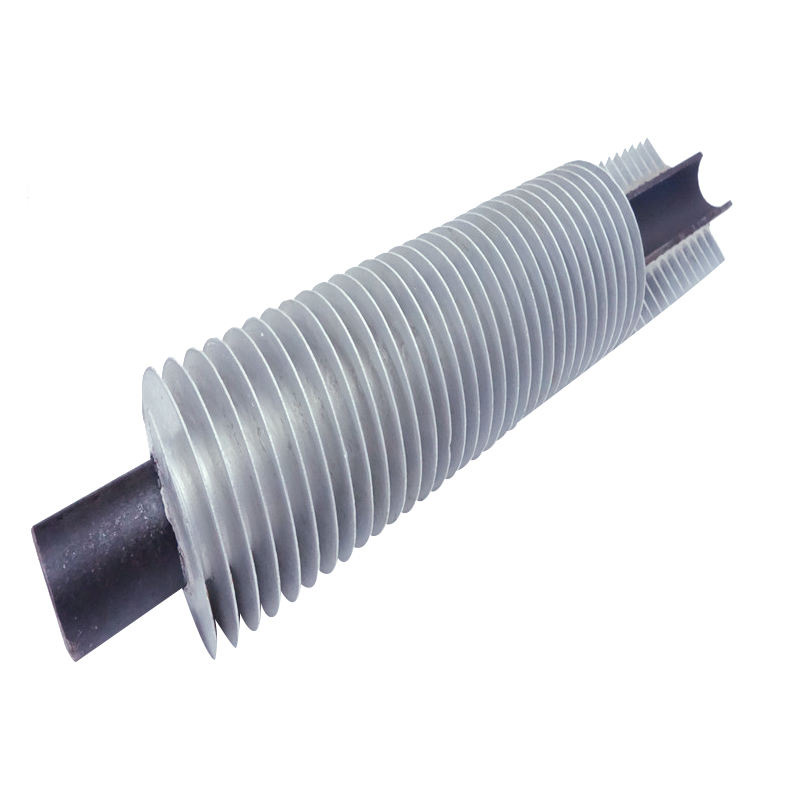
In essence, Extruded Fin Tubes are finned tubes where the fins have been formed using an extrusion process.
The fin material commonly takes the form of an aluminium sleeve that fits around the exterior of a base tube.
Then, tooling forces the aluminium material to form a series of continuous fins around the outside of the tube.
As a result, the extrusion process ensures there is strong physical contact between the fin material and tube material.
Some key components of an extruded fin tube include:
- Base tube
- Aluminium outer layer
- Extruded fins
- Fin root
- External heat transfer surface
The base tube can be made from materials such as:
- Carbon steel
- Stainless steel
- Copper
- Alloy steel
- Other suitable metals
On the other hand, aluminium is commonly used to form the external fins on the tube.
As a result, manufacturers can easily combine a strong base tube with a thermally efficient aluminium external surface.
3. How Extruded Fin Tubes Work
By increasing the external surface area, extruded fin tubes enable more efficient heat transfer to or from air.
First, a working fluid flows through the inside of the tube.
Heat is then transferred through the wall of the tube.
Heat then passes through the tube wall into the aluminium outer layer.
Finally, fins transfer heat to or from air that flows around the outside of the tube.
This large surface area allows the tube to dissipate or absorb a larger quantity of heat.
Because the fins are mechanically bonded to the tube during extrusion, there is also low thermal resistance at the interface.
As a result, this provides an efficient heat transfer medium for air-side applications.
Heat transfer also depends on fin geometry.
As a result, engineers can specify different fin heights, thicknesses and pitches to meet the requirements of their application.
4. Extruded Fin Tube Manufacturing Process
Specialized extrusion tools allow manufacturers to produce extruded fin tubes.
The extrusion process involves a number of key stages.
4.1 Base Tube Preparation
Initially, manufacturers must choose the appropriate base tube material.
Important factors include:
- Working fluid
- Operating temperature
- Working pressure
- Corrosion considerations
- Mechanical strength requirements
Therefore, the base tube material selection should be based on the intended application.
4.2 Aluminium Sleeve Installation
Next, an aluminium sleeve is prepared.
This sleeve will fit over the outside of the base tube.
It will then be formed into fins during the extrusion process.
Therefore, manufacturers must carefully control the dimensions of the aluminium sleeve.
4.3 Extrusion and Fin Forming
The aluminium sleeve is placed into specialized tooling which forces the aluminium to form fins around the tube.
The result is a fin structure which is mechanically integrated with the base tube.
Important fin parameters include:
- Fin height
- Fin pitch
- Fin thickness
- Outer diameter
- Fin profile
Therefore, manufacturers can customize fin geometries to create a range of different fin configurations.
4.4 Mechanical Bonding
As described earlier, the extrusion process creates a strong mechanical bond between the aluminium layer and the base tube.
This mechanical bonding ensures that there is low thermal resistance at the interface.
The integrated design also provides excellent mechanical stability.
4.5 Cutting and Straightening
After the extrusion process is complete, fin tubes are cut to length.
They are also straightened where necessary.
As a result, the finished tubes meet all requirements for assembly into heat exchangers.
4.6 Inspection
Finally, inspectors will examine the finished extruded fin tubes.
Typical inspection criteria includes the following:
- Tube diameter
- Fin height
- Fin pitch
- Fin thickness
- Quality of fin attachment
- Surface condition
- Tube straightness
By carefully inspecting finished products, manufacturers can ensure consistent quality.
5. Main Advantages of Extruded Fin Tubes
Customers can benefit from several advantages when they use extruded fin tubes.
5.1 Excellent Thermal Contact
The extrusion process ensures there is excellent thermal contact between the aluminium fins and base tube.
As a result, heat can be rapidly transferred into the fins.
Good thermal contact helps ensure efficient heat transfer performance.
5.2 Large Heat Transfer Surface
Due to the addition of fins, extruded fin tubes provide a much larger external surface area.
As a result, the heat exchanger can transfer more heat.
The large surface area allows users to fit more heat transfer tubes into a smaller space if required.
5.3 Strong Mechanical Bond
The mechanical bonding process used to create extruded fins ensures there is a strong mechanical bond between the fins and tube.
Therefore, the fins can withstand suitable levels of vibration and thermal cycling.
This makes extruded fins ideal for many industrial heat exchanger applications.
5.4 Good Corrosion Resistance
Aluminium resists atmospheric corrosion very well.
As a result, customers can use aluminium extruded fin tubes in outdoor applications.
However, we always recommend that engineers analyse the intended operating environment beforehand.
5.5 Lightweight Construction
Due to the low density of aluminium, extruded fin tubes are very lightweight.
This can make them easier to transport and install.
5.6 High Fin Density
The extrusion process allows manufacturers to create fins with very small pitches if required.
As a result, engineers can significantly increase the available surface area for heat transfer.
High fin densities can increase air resistance. As a result, there is a trade off which designers must consider.
5.7 Long Service Life
Movement of the fins is unlikely due to the strong fin structure.
Aluminium also has excellent resistance to the environment.
Therefore, customers can expect extruded fin tubes to provide many years of reliable service if they are used in suitable applications.
6. Extruded Fin Tube Materials and Designs
Applications can require different materials for the base tube and fins.
6.1 Aluminium Extruded Fin Tubes
The fins are commonly made from aluminium extrusions.
Aluminium offers:
- High thermal conductivity
- Low weight
- Corrosion resistance
- Ease of forming
As a result, aluminium fin tubes are commonly used in air side heat transfer applications.
6.2 Steel Tube with Aluminium Fins
Many manufacturers combine a steel tube with aluminium fins.
The steel base tube provides strength and durability.
However, aluminium allows efficient heat transfer to take place on the outside of the tube.
Therefore, customers can benefit from an ideal compromise of strength and heat transfer performance.
6.3 Stainless Steel Tube with Aluminium Fins
Stainless steel offers superior corrosion resistance.
As a result, this material combination excels in corrosive industrial environments.
Customers have used stainless steel tubes with aluminium fins for chemical processing and industrial cooling.
6.4 Copper Base Tube
Copper offers superior thermal conductivity among all metals.
Therefore, copper provides excellent thermal performance when used as a base tube material.
Nevertheless, engineers should select materials based on their application’s specific requirements.
7. Extruded Fin Tubes Applications
Users from many different industries benefit from the advantages of extruded fin tubes.
7.1 Air Cooled Heat Exchangers
Heat exchangers that are cooled by air require a large external surface area for heat transfer.
Therefore, engineers can use extruded fin tubes to provide this surface area in a convenient form.
Applications for which our customers have used air cooled heat exchangers include:
- Process coolers
- Oil coolers
- Gas coolers
- Condensers
Air Cooled Heat Exchanger Solutions from Bangwin Thermal
7.2 HVAC Systems
HVAC units require heat transfer to or from air.
Therefore, extruded fin tubes can be used in many HVAC applications, such as:
- Heating coils
- Cooling coils
- Air conditioning equipment
- Heat pump systems
The small space requirements enabled by fin tubes can also allow designers to create more compact HVAC systems.
7.3 Refrigeration Equipment
The compact size and excellent heat transfer performance of extruded fin tubes make them suitable for many refrigeration systems.
Applications include evaporators and condensers.
7.4 Industrial Oil Coolers
Oil cooling applications require heat to be transferred away from the oil and into air.
As a result, extruded fin tubes are useful in applications such as:
- Hydraulic oil cooling
- Lubricating oil cooling
- Cooling of industrial machinery
7.5 Petrochemical Equipment
Petrochemical applications often use air cooled heat exchangers for cooling.
Suitable applications include:
- Process cooling
- Heat recovery
- Gas cooling
- Condensing
7.6 Power Generation
Power plants contain many heat transfer applications.
Examples where our customers have used extruded fin tubes in power generation plants include:
- Cooling applications
- Heat recovery
8. Extruded Fin Tubes vs Welded Fin Tubes
Both welded and extruded fin tubes allow manufacturers to increase the surface area available for heat transfer.
However, there are important differences between the two methods of attachment.
Feature | Extruded Fin Tubes | Welded Fin Tubes |
Fin Connection | Extruded mechanical bond | Welded connection |
Fin Material | Often aluminium | Steel or aluminium |
Thermal Contact | Excellent | Excellent |
Corrosion Protection | Good | Depends on materials |
High-Temperature Use | Moderate to high | High |
Manufacturing | Extrusion | Welding |
Typical Use | Air cooling | Industrial heat transfer |
Extruded fin tubes are better for applications that require lightweight construction and good thermal contact.
Meanwhile, welded fin tubes are preferable for high temperature heat transfer applications.
High Frequency Welded Fin Tube
9. Extruded Fin Tubes vs Embedded Fin Tubes
Embedded fin tubes and extruded fin tubes offer another way to create strong mechanical fin attachment to tubes.
However, the ways the fins attach to the tube differ.
Feature | Extruded Fin Tube | Embedded Fin Tube |
Fin Installation | Extrusion | Groove insertion |
Tube Preparation | Sleeve or outer layer | Machined groove |
Fin Bond | Mechanical extrusion | Embedded mechanical |
Fin Material | Commonly aluminium | Aluminium or other metals |
Corrosion Protection | Good | Depends on design |
Typical Application | Air coolers | Industrial heat exchangers |
Therefore, the ideal solution for your application will depend on factors such as temperature, materials, and thermal performance requirements.
10 Choose Extruded Fin Tubes
Selecting a proper extruded fin tube requires evaluation of several factors.
10.1 Heat Transfer Considerations
Determine the heat duty needed for the application.
Calculate the required heat transfer area.
Engineers can then choose appropriate fin dimensions.
10.2 Temperature Considerations
Decide what temperature range the heat exchanger will work in.
Aluminium fins are compatible with many different applications.
However, extremely high temperatures could damage aluminium fins.
Engineers should choose a fin material that matches application requirements.
10.3 Pressure Considerations
The tube should be able to handle the process pressure.
Engineers should then choose appropriate tube dimensions and wall thickness.
10.4 Corrosion Considerations
Take note of humidity, exposure to chemicals, salt spray, outdoor installations etc.
Engineers should choose suitable tube materials and fin materials based on this information.
10.5 Fin Configuration
- Fin height
- Fin pitch
- Fin thickness
- Fin density
- Tube outer diameter
Heat transfer and airside pressure drop are affected by these variables.
Engineers should carefully design the entire fin configuration.
10.6 Airflow Considerations
Fin density can increase the surface area available for heat transfer.
Fin density will also increase the pressure drop.
Designer should consider thermal performance and fan power requirements.
11 Why Choose Bangwin Thermal
Bangwin Thermal is an industrial supplier of fin tube and heat exchanger products.
Our catalog includes several different fin tube technologies.
These technologies include:
- Extruded fin tubes
- Aluminium extruded fin tubes
- G type fin tubes
- KL fin tubes
- Low fin tubes
- Serrated fin tubes
- Longitudinal finned tubes
- Spiral welded fin tubes
- High frequency welded fin tubes
- Laser welded fin tubes
Additionally, we are able to provide customized heat exchanger designs to meet industrial needs.
Our experts can help you figure out your needs for:
- Heat duty
- Tube material
- Fin material
- Fin configuration
- Operating temperature
- Working pressure
- Airflow considerations
- Corrosive conditions
Customers can choose the best fin tube solution for their project.
Bangwin Thermal Factory
Visit Bangwin Thermal Official Website
12 FAQ
- What are extruded fin tubes?
Extruded fin tubes are fin attachments that are extruded around a base tube.
As a result of the extrusion process, there is a large surface area of contact between the fins and the tube.
- What materials are used for extruded fin tubes?
The fins are commonly made from aluminium.
The tube could be carbon steel, stainless steel, copper, or copper alloy.
- What are extruded fin tubes used for?
Applications include air cooled heat exchangers, HVAC equipment, refrigeration, oil coolers, and industrial process equipment.
- What are the advantages of extruded fin tubes?
Some advantages include:
Large heat transfer surface area
Strong mechanical bond between fin and tube
Lightweight
Corrosion resistance
- Can extruded fin tubes be used for high temperatures?
Extruded fin tubes can be used in many industrial applications involving high temperatures.
One issue is that aluminium fins have lower temperature limits.
As such, engineers should evaluate the temperature range of the application before choosing a fin material.
- Are extruded fin tubes better than welded fin tubes?
Welded and extruded fin tubes each have their own advantages and disadvantages.
Extuded fin tubes offer better thermal contact between the fin and tube.
They are also typically lighter in weight than welded fin tubes.
Welded fin tubes are often used in higher temperature services.
- What is the difference between extruded fin tubes and G type fin tubes?
Extruded fin tubes have fins that are extruded around the tube.
G type fin tubes have fins inserted into grooves that are cut into the tube.
As a result, these two fin configurations have different thermal and mechanical properties.
- Does Bangwin Thermal offer custom extruded fin tubes?
Yes. Bangwin Thermal offers customized extruded fin tubes.
We can customize tube material, fin material, fin height, fin thickness, fin pitch, and more.
13 Conclusion
Overall, Extruded Fin Tubes are a great way to increase the surface area for heat transfer.
The extrusion process allows the external fins to have good contact with the base tube.
Aluminium provides high thermal conductivity, while also being light weight and corrosion resistant.
These characteristics make extruded tubes ideal for many heat exchanging applications on the air side.
Typical applications are air cooled exchangers, HVAC equipment, refrigeration, oil coolers, petrochemical equipment, and power generation equipment.
When choosing extruded fin tubes, engineers should take into account heat duty, temperature, pressure, corrosion, airflow, and fin geometry.
Bangwin Thermal can provide custom extruded fin tubes for your industrial heat exchanger needs.
We have the experience to help you choose the right heat exchanger, and the manufacturing capabilities to build it.